Showing posts with label Slovenia. Show all posts

Friday, April 25

Slovenia 2025

Slovenia

Date of Issue: 9th May 2025

two stamps (1.79 & 2.06 €)


both stamps are issued in mini-sheets of 8 stamps + 1 vignette​


Bronze Apollo statuette  

This 11.5 cm high statuette was found in the river Ljubljanica near the village of Blatna Brezovica. It depicts a naked male figure with a hairstyle typical of Classical/Hellenistic depictions of the Greek and Roman god Apollo. The collar, however, does not match traditional depictions of Apollo and is a distinctly Celtic element. The pose of the body and the position of the arms are reminiscent of Italo-Etruscan statuettes. This statuette is assumed to have been made in north-eastern Italy or its eastern hinterland, including the wider surrounding area of the site where it was found. It was probably made during the period of the Romanisation of the Vrhnika and Ljubljana areas in the middle or second half of the first century BC. It represents a non-Roman deity who, under the influence of Roman culture, was identified with Apollo. This deity could be the god Belenus, whose cult extended across north-eastern Italy and the region known as Noricum (mainly in present-day Austria), and who was of pre-Roman origin. There are no known depictions of Belenus – with the possible exception of this statuette from the Ljubljanica – but he is known of from Roman-era inscriptions, in which he is referred to as Apollon Belenus.  The statuette is thought to have been thrown into the river as a votive offering.

Centaur archer

Round brooches made of plated bronze over an iron core are relatively common finds in Slav cemeteries from the eighth and ninth centuries in Slovenia's Gorenjska region. Notable among them, for the quality of workmanship and, above all, for the depiction of a centaur archer, is this brooch from the Brda cemetery near Bled.

In stylistic terms it belongs to Carolingian art, which drew on illuminated manuscripts. Most comparable artefacts are from sites in the Upper Danube basin and the Rhineland. The figure of the centaur archer developed in Babylonian art before 1000 BC as a symbol of the zodiac sign Sagittarius. It entered Roman and medieval astrological depictions of Sagittarius via Egypt and was later adopted in Christianity.

We will probably never know exactly how this brooch ended up in a Slav grave in the Brda cemetery near Bled. It may have been made by a Christian who based the design on an illustration from an illuminated manuscript. On the other hand, the Slavs, who were pagans when they settled this area in the sixth century and whose Christianisation under the Carolingians had only just begun in the eighth century, probably did not see this design as a Christian symbol but as a pagan one. The centaur archer may have reminded them of Perun the Thunderer, the supreme god of the Slavs, who could also be depicted as a horseman with a thunderbolt or bow in his hand.

Tuesday, May 28

Slovenia 2024

Slovenia

Date of Issue: 31st May 2024

two stamps (C & D values = 1.69 & 1.96 €)


both stamps are issued in mini-sheets of 8 stamps + 1 vignette

1. Fan mussel (Pinna nobilis) - IUCN Red list - Wikipedia article

2. Water beetle (Graphoderus bilineatus) - IUCN Red list - Wikipedia article

Wednesday, May 24

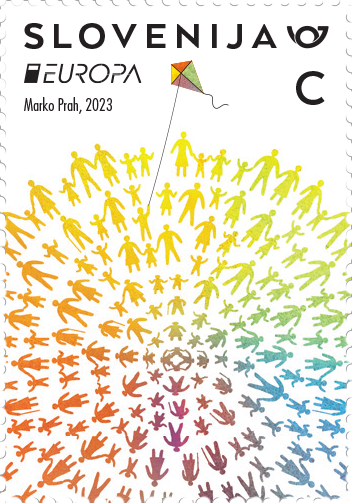
Slovenia 2023

Slovenia

Date of Issue: 25th May 20232

two stamps (C & D values = 1.50 & 1.67 €)


both stamps are issued in mini-sheets of 8 stamps + 1 vignette


Tuesday, May 17

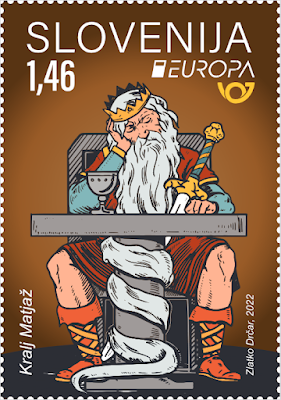
Slovenia 2022

Slovenia

Date of Issue: 27th May 2022

two stamps (1.33 & 1.46 €)

both stamps are issued in mini-sheets of 8 stamps + 1 vignette


The Giantess (Ajdovska deklica) is one of many mythological figures in a Slovene folk tradition that tells of a mountain-dwelling race of giants. These giants were said to have lived “long ago”, so stories about them are though to contain popular beliefs about the original inhabitants of the land. Stories about giants and giantesses vary considerably. People used to explain ancient material remains and prehistoric burial mounds as giantish structures. The former inhabitants of these structures were said to be trapped by enchantments in the ruins – or in some cases even in the walls of churches, as with the story of the giantess’s rib in the pilgrimage church at Crngrob near Škofja Loka. There are many tales and legends about giants and giantesses, but perhaps one of the best known is the story of the petrified giantess on the face of Prisank, a mountain near Kranjska Gora. According to the legend, a giantess prophesied that a hunter’s newborn son would grow up to be a hunter like his father and would one day shoot the golden-horned chamois known as Zlatorog. This prediction angered the other giantesses, who turned their fortune-telling sister to stone, trapping her on the side of a mountain, where she can still be admired today by the many visitors to Slovenia’s Julian Alps.

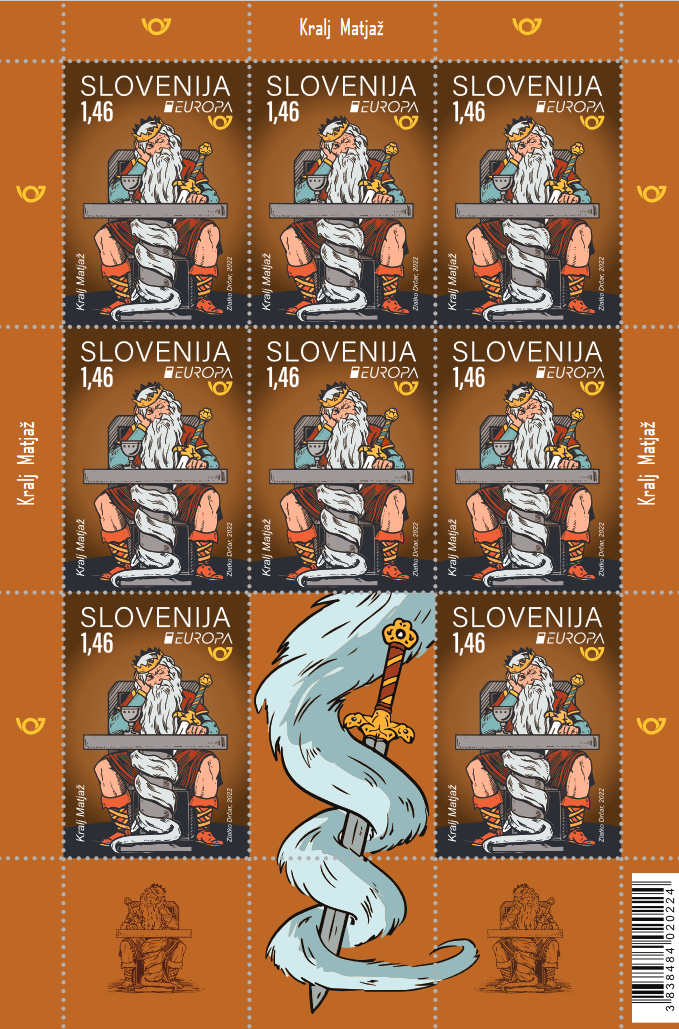
King Matjaž is a well-known figure in the literary folklore of Slovenia. The basis for many legends of King Matjaž is the Hungarian king Matthias Corvinus (1458–1490), who distinguished himself in the defence against the Ottoman invaders and also ensured tolerable living conditions for Slovene peasants. Stories about King Matjaž do not have a basis in historical fact but have merely taken the king’s name. Similar stories are told in Hungary, Slovakia, Romania and Croatia. The first written texts about King Matjaž date from the sixteenth century. Over time, numerous other elements were added to the original tale. These were of Indo-European, Oriental and medieval origin and in some cases
can be linked to King Arthur, Charlemagne, Frederick Barbarossa and Frederick II. In amongst this multitude of elements of diverse origin, the version of the tale most commonly told in Slovenia is that of King Matjaž asleep with his army beneath a mountain (in this case the mountain is Peca/Petzen, which straddles the border between Slovenia and Austria). Legend has it that when he awakes and appears once again, good times will return. It seems that he will continue to sleep for a long time!


Tuesday, May 11

Slovenia 2021

Slovenia

Date of Issue: 28th May 2021

two stamps (1.22 & 1.37 €)

both stamps are issued in mini-sheets of 8 stamps + 1 vignette


Thursday, March 19

Slovenia 2020

Slovenia

Date of Issue: 29th May 2020 - 13th July 2020

two stamps (C & D value (1.17 & 1.31 €))


both stamps are issued in mini-sheets of 8 stamps + 1 vignette

Monday, September 23

Best Europa stamp 2019 - Jury prize

Slovenia

The 2019 Best Europa stamp - Jury prize was awarded last Saturday in Brussels’ town hall.

This was the 8th edition of this neutral and artistic prize.

Six experts of the philatelic world were invited to join the jury and judge the Europa stamps based on their expert opinion.

This year's winner is Slovenia with a stamp part of a 2 stamps set - it's the first time that Slovenia wins the Jury prize !


2nd – Liechtenstein (stamp under)
3rd - Finland (stamp under)

This year's Jury was composed as follow (from the left to the right) :


• Antonio Manuel Amaral, PostEurop's coordinator (not part of the jury)
• Guy Coutant, Pro Post, Belgium (co-chair)
• Botond Szebeny, PostEurop's Secretary General, Hungary (co-chair)
• Andrée Trommer, General secretary of the Fédération internationale de philatélie (FIP), Luxembourg
• Stefan Klein, Stamp designer, Germany
• Arie Piet, Director Stamp Printing National Bank Belgium, the Netherlands
• Olaf Neumann, Stamp designer, Germany

The winner of the public prize will be announced during PostEurop's plenary assembly in Jersey, in October.

Friday, February 22

Slovenia 2019

Slovenia

Date of Issue: 31st May 2019

two stamps (1.31 & 1.45 €)


both stamps are issued in mini-sheets of 8 stamps + 1 vignette


NOTE - This set is taking part at "The Europa Stamps Bird Project 2019" which allows you to scan the stamps in order to hear the bird's song

Wednesday, July 4

Special 2018 Europa folder issued by 7 countries

Europe

After, the three first issues of this kind :  2013 (theme - "The postman van") ; 2016 (theme - "Ecology in Europe - Think Green", & 2017 (theme - Castles) :

7 countries - Austria - Germany - Liechtenstein - Luxembourg - the Netherlands - Switzerland and this year joined by Slovenia - issued a common "Multilaterale" folder containing this year's Europa stamps from the seven countries (12 stamps).


This folder can be ordered by any of the 7 postal administrations.

Friday, April 20

Slovenia 2018

Slovenia

Date of Issue: 25th May 2018

two stamps (1.15 & 1.26 €)


both stamps are issued in mini-sheets of 8 stamps + 1 vignette

Friday, May 26

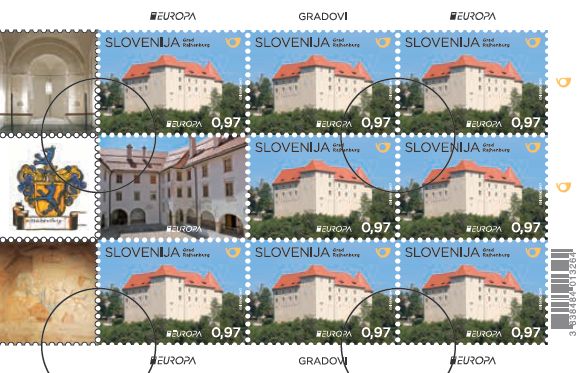
Slovenia 2017

Slovenia

Date of Issue: 26th May 2017

two stamps (0.97 & 1.26 €)


both stamps are issued in mini-sheets of 8 stamps + 1 vignette

Wednesday, May 18

Slovenia 2016

Slovenia

Date of Issue: 27th May 2016

two stamps (0.64 & 0.97 €)


both stamps are issued in mini-sheets of 8 stamps + 1 vignette