Bosnia and Herzegovina (Croat post)
Date of Issue: 5th April 2026
one stamp (4.- BAM) & 1 souvenir-sheet (4.- BAM)


this stamp is issued in a mini-sheet of 8 stamps with 2 vignettes


europa, cept, norden and sepac stamps information blog
Bosnia and Herzegovina (Croat post)
Date of Issue: 5th April 2026
one stamp (4.- BAM) & 1 souvenir-sheet (4.- BAM)
this stamp is issued in a mini-sheet of 8 stamps with 2 vignettes
Bosnia and Herzegovina (Croat post)
Date of Issue: 5th April 2025
two stamps (2x 3.50 BAM) & 1 souvenir-sheet of 2 stamps (2x 3.50 BAM)


both stamps are issued in a mini-sheet of 8 stamps (4 of each) with 2 vignettes

Motif of an archaeological find from 1880, known as Glasinačka kolica (Glasinac cart). It was found by the Austro-Hungarian lieutenant Johann Lexa and handed over to the Naturhistorisches Museum in Vienna, where it is still kept today. Its replica is housed by the National Museum of Bosnia and Herzegovina in Sarajevo.
The cult bronze cart with representations of waterfowl probably had a ritual purpose connected with the cult of the Sun. Researchers date this find to the 7th century BC. In terms of motif and style, it relies on the tradition of the Late Bronze Age, when waterfowl were the dominant symbol of the "Urnfield Culture" (the ritual of burning the deceased and storing the ashes in urns that were then buried in earthen graves).
The Glasinac cart consists of four interconnected wheels with two imaginary birds on top, which have the body of a dove, the beak of a marsh bird, the crest of a rooster and the ears of a bull. On the lower larger bird, which is hollow inside, a smaller bird sits as a lid. On each axle there is another smaller bird as decoration. The cart is 19 cm long, 10 cm wide and 15 cm high, and weighs 1055 g. It was used in rituals as a vessel for embers to burn fragrant substances, and was left in the deceased's grave.
Bosnia and Herzegovina (Croat post)
Date of Issue: 5th April 2024
two stamps (2x 3.50 BAM) & 1 souvenir-sheet of 2 stamps (2x 3.50 BAM)


both stamps are issued in a mini-sheet of 8 stamps (4 of each) with 2 vignettes

1. Acetabularia acetabulum - Wikipedia article
2. Date shell (Lithophaga lithophaga) - Wikipedia article
Bosnia and Herzegovina (Croat post)


both stamps are issued in a mini-sheet of 8 stamps (4 of each) with 2 vignettes
 Bosnia and Herzegovina (Croat post)


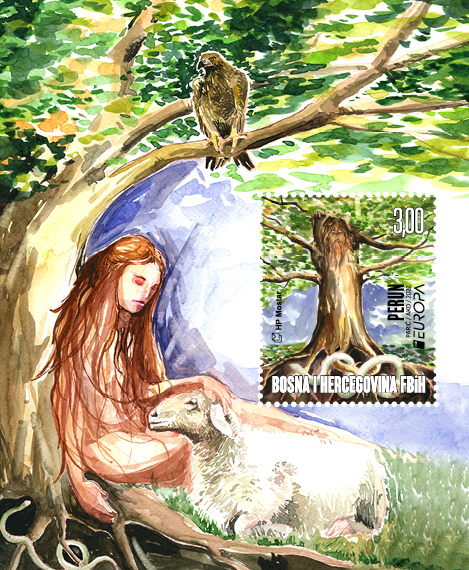
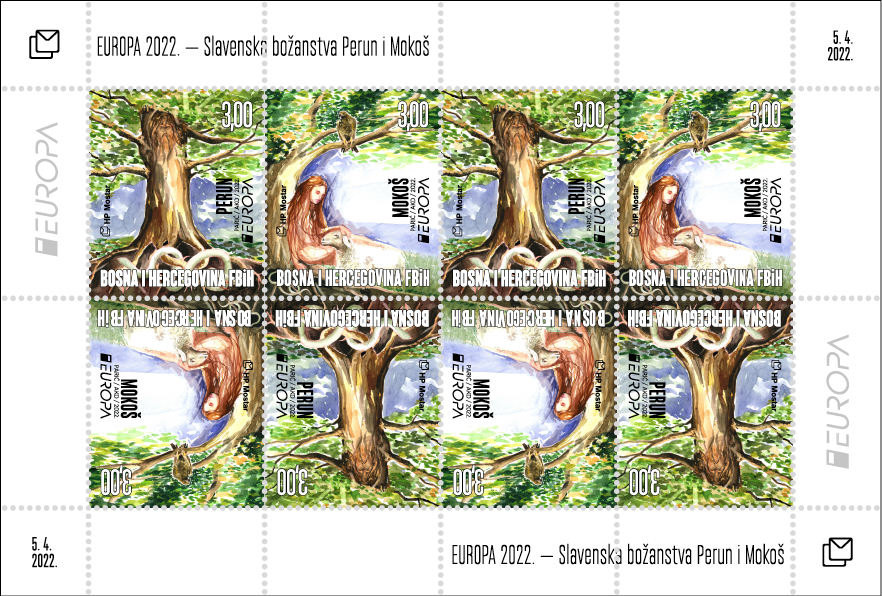
The Slavic people worshiped various deities, and research has led to the fact that the god of thunder and lightning, Perun, is considered the supreme god of the Slavic pantheon. He rules the living world by dwelling in a fort on the highest branch of the tree of life. His wife is the goddess of fertility and protector of women, Mokosh. She is the mother of the wet Earth and the bright Sun. Perun is depicted as a rough red-haired man, symbolized by an eagle sitting on an oak branch watching the world. The water god of the underworld, Veles, is his enemy who lives at the root of the tree of life and is symbolized by the serpent. The most significant myth of Slavic mythology is the struggle between Perun and Veles who steals the Sun - Mokosh and takes her to the underworld, where she spends half a year. Perun pursues Veles with his lightning and thunder and expels him to the underground to bring back Mokosh and restore order. The myth was repeated every year in a circular cycle following the movement of the Sun and the seasons. (Željka Šaravanja)
Bosnia and Herzegovina (Croat post)


 Bosnia and Herzegovina (Croat post)


 Bosnia and Herzegovina (Croat post)


 Bosnia and Herzegovina (Croat post)


 Bosnia and Herzegovina (Croat post)