Showing posts with label 1974. Show all posts

Friday, July 31

Belgium 1974 - Focus

Belgium

4th May 1974 - "Sculpture"
design : Jean Malvaux
engraver : Jean de Vos
printer: Zegeldrukkerij van Mechelen - Belgium

The first stamp (5 Belgian francs) shows the work De verwoeste stad (The Destroyed City) by the French naturalized Belarusian artist Ossip Zadkine (1888-1967).

image source Ibolli

This sculpture conceived in 1947 represents a man without a heart. It is a memorial to the destruction of the centre of Rotterdam in 1940 after the Luftwaffe bombing.

The figure holds both hands aloft, with its head thrown back as if crying in grief, and a gaping hole in its chest and abdomen. The absence of a heart is said to symbolize the destruction of the centre of Rotterdam. Zadkine described it as "A cry of horror against the inhuman brutality of this act of tyranny".


image source Wikimedia
At the 1958 Brussels World Fair (Expo 58), a smaller bronze version (128 × 57.5 × 56.5 cm) was exhibited and acquired by the Royal Museums of Fine Arts of Belgium.

The second stamp (10 Belgian francs) shows the work Solidariteit (Solidarity) by the Flemish artist George Minne (1866-1941).

image source Ibolli

This work of 1934 represents two men supporting each other. The bronze work is located in the centre of a pond in the municipal park of Boom.


1974

Europe

Issue n°19 - 1974

"Sculptures"

Number of countries : 23
Debuting countries : none
Returning countries : Sweden
Withdrawing countries : the Netherlands, Norway

Since 1974, a common theme replaces the common design system used since 1956! Only the CEPT logo (or letters) on each stamp indicates that the stamp is a "Europa stamp".

08.05.1974 Austria
04.05.1974 Belgium
29.04.1974 Cyprus
29.04.1974 Finland
22.04.1974 France
10.05.1974 Greece
29.04.1974 Iceland 
29.04.1974 Ireland 
29.04.1974 Italy
21.03.1974 Liechtenstein
29.04.1974 Luxembourg
13.07.1974 Malta
08.05.1974 Monaco
29.04.1974 Portugal
09.05.1974 San Marino 
29.04.1974 Spain 
29.04.1974 Sweden
28.03.1974 Switzerland
29.04.1974 Turkey 
17.04.1974 West-Germany 
29.04.1974 Yugoslavia 
 
Note : The theme for the years 1974-76 was "Work of art" subdivided like this : 
"Sculptures" in '74 ; "Paintings" in '75 and "Handicrafts" in '76.
 
Interesting to note, that the CEPT logo is depicted on the stamps of only 15 countries, the other 8 countries just add the CEPT letters on their stamps. 
 
Most stamps issued on the 29th April.


more here in the Europa stamps History - Part III

Eurovision Song Contest 1974
Brighton (Great-Britain)
Winner: ABBA "Waterloo" (Sweden)
 
my personal favourite that year: Gigliola Cinquetti "Si" (Italy) 


Sunday, July 26

Austria 1974 - Focus

Austria

8th May 1974 - "Sculpture"
design : Adalbert Pilch
engraver : Rudolf Toth
printer: Österreichische Staatsdruckerei - Austria

The stamp of Austria shows the statue of King Arthur - König Artur -  from the imperial tomb "Cenotaph" of the Holy Roman Emperor Maximilian I in the Court Church - Hofkirche - in Innsbruck.

image source Ibolli

With this group of figures, the church houses the most important funerary monument in the West. The centrepiece is the cenotaph on which the emperor kneels, facing the altar in a prayerful posture. Relief paintings by the Dutch master Alexander Colin depict the colourful and eventful life of the emperor.
 

image source Wikimedia

The cenotaph is surrounded by 28 large bronze statues (200–250 cm) of ancestors, relatives and heroes. Their creation took place between 1502 and 1555, and occupied a number of artists. The statue of and King Arthur was made by Albrecht Dürer in 1513.

image source Wikimedia

Wednesday, July 22

Andorra (Spanish post) 1974 - Focus

Andorra (Spanish post)

29th April 1974 - "Sculpture"
design : unknown
printer: Fábrica Nacional de Moneda y Timbre (FNMT) - Spain

Like the French post office, Andorra's Spanish post office has chosen a polychrome wooden virgin from the Romanesque period to illustrate the theme of "Sculpture".

image source Ibolli

This virgin appears on the first stamp (2 pesetas) and represents La Verge d'Ordino (The Virgin of Ordino) which is located in the church of Sant Corneli i Sant Cebrià in Ordino.  This 44-cm virgin is the smallest in the Principality and dates from the late 11th and early 12th centuries.

 image source Wikimedia Commons

The second stamp (8 pesetas) represents the Creu de les set banves [Creu dels set
braços]
, the seven-branched cross.


image source Ibolli

This Gothic cross with seven branches dates from the 16th century. It is located on the road between Prats and Meritxell. There is a legend associated with it, which you can read on the website of the Andorra Tourist Office.


Saturday, July 18

Andorra (French post) 1974 - Focus

  Andorra (French post)

27th April 1974 - "Sculpture"
design & engraving : Albert Decaris
printer: Imprimerie des Timbres-poste et des ValeursFiduciaires (ITVF) - France

Andorra is rich in Romanesque churches. In 1974, the French Post of Andorra selected two "Virgins in Majesty" from this period to illustrate the common theme of "Sculpture".

These reliquary virgins were carried in procession and then placed on altars or embedded in the tympanums of churches.

 
image source Ibolli

The first stamp represents La Vierge de Pal (the Virgin of Pal, or it's exact name the Verge del Remei in Catalan) which is kept in the church of Sant Clement in Pal. This 12th century sculpture was restored in 1988. The virgin is holding an apple - symbolic of power - in her right hand.

  image source Diari d'Andorra

The second stamp shows La Vierge des remèdes de Santa Coloma (the Virgin of the Cures of Santa Coloma) from the 13th century and kept in Andorra's oldest church in Santa Coloma.

image source Ibolli

The child Jesus holds the apple in his left hand and extends his right hand in a gesture of blessing. Mary is carrying a container interpreted by tradition as the "vase of heavenly ointments".
 
 image source Wikimedia Commons

Sunday, September 4

San Marino 1974 - focus

San Marino

9th May 1974 - "Sculptures"
design: V. Nicastro & R. Di Giuseppe
printer: I.P.S. Roma

I decided to start a new type of messages to put a bit life in this blog when the Europa stamps season is a bit down.

I will focus on a stamp or set of the Europa stamps collection. This idea is inspired by the blog of Tomoko - well centred - I hope she won't mind !

The first set I chosed, is the 1974 issue of San Marino.


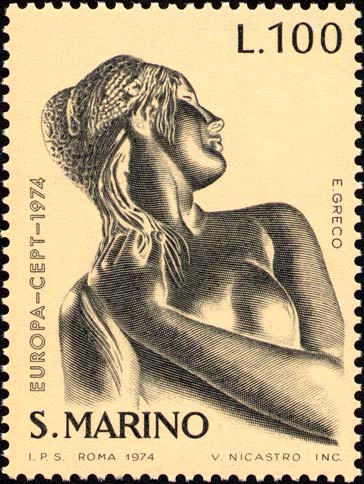
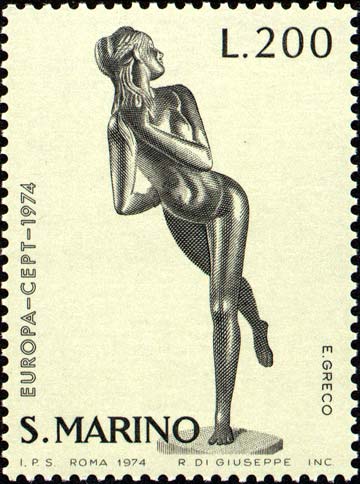
It's my favourite issue of that year. The beauty of the sculpture is very well given back by the quality of the engraving (two engravers for this set, one for each stamp !). It's also interesting to see that both stamps from this set are representing the same sculpture - a close up of the head and a full size image of the whole sculpture. One more thing I really like about this issue is the use of colored paper. It so much nicer than having a border around the stamp in my opinion. It emphasis the stamp on a cover especially a white one.


About the sculpture: it's a work of Emilio Greco, Italian sculptor born in Sicily almost hundred years ago. I think the work shown on both stamps is "Grande Pattinatrice n.2" (= great skater) of 1971. Surprisingly this sculpture can't be seen in San Marino but in Orvieto in Italy in the Emilio Greco Museum.

Thursday, August 2

the Europa stamps history - III

Europe

The Europa stamps history

part III - The common themes
(1974-1989)


1974 was an important year for the Europa stamps collection, because since then, a common theme replaced the common design system used since 1956! Only the CEPT logo (or letters) on each stamp indicates that the stamp is a "Europa stamp".

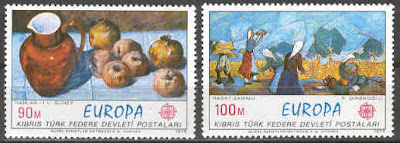
That year, the first theme to be chosen was sculptures (23 countries ; 49 stamps). The next year (1975) the theme was paintings (24 countries ; 50 stamps). It was also the first Europa issue of the Turkish part of Cyprus. Due to the political situation on the island of Cyprus, the stamps issued by the Turkish part of the island aren't recognized on an international level. Even if those stamps bear the Europa logo, they are not official Europa stamps but most of the Europa stamps collectors collect them as they issue Europa stamps on a regular basis since 1975 !

In 1976 the common theme was handicrafts (27 countries ; 58 stamps). Two new postal administrations appeared that year, Guernsey and the Isle of Man which still issue Europa stamps those days ! 1977 (28 countries ; 56 stamps), landscapes. 1978 (30 countries ; 65 stamps), monuments. Jersey took part for the first time that year. In 1979 (31 countries ; 68 stamps) the theme was postal history. The Faroe islands and Gibraltar are taking part since that year. Gibraltar isn't in fact a CEPT member but issue each year 4 stamps on the same topic as the Europa stamps but without the official logo. As they are British colony on European soil those issues were always tolerated.

The theme for 1980 (32 countries ; 67 stamps) was famous people. In 1981 (35 countries ; 69 stamps) the theme was folklore and feasts. For the first time the Azores and Madeira issued Europa stamps under their own name. 1982 (35 countries ; 70 stamps) : historic events. 1983 (35 countries ; 71 stamps) : inventions.


In 1984 (35 countries ; 67 stamps) the CEPT was 25 years old (1959-1984). To celebrate this event it has been decided to use a common design again as it was the case before 1974. The common design was a bridge designed by the French engraver Jacky Larrivière.

1985 (35 countries ; 73 stamps) was the European Music Year and the ideal topic for Europa stamps that year. 1986 (35 countries ; 74 stamps) : nature conservation. 1987 (35 countries ; 74 stamps) : modern architecture. 1988 (35 countries ; 79 stamps) : transportation . 1989 (35 countries : 80 stamps) : children's games.

Till 1981, the number of countries issuing Europa stamps grew up till a record number of 35, especially with the venue of Dependencies and Autonomous country parts. The number of 35 stayed stable until 1990 but the number of stamps grew up till a record number of 80 in 1989!

In November 1989 the Berlin Wall fell putting an end to the Iron curtain division between East and West, between the old and the new Europe. This brought many changes to the face of Europe not only politically but also culturally and also in the Europa stamps collection as we will see in the fourth part of this "Europa stamps history"...


Part I
- The early years (1956-1959)
~
Part II - The birth of the CEPT (1960-1973)
~

Part IV - The new Europe (1990-1999)
~
Part V - The new millennium (2000-)