Showing posts with label history. Show all posts

Friday, July 31

Belgium 1974 - Focus

Belgium

4th May 1974 - "Sculpture"
design : Jean Malvaux
engraver : Jean de Vos
printer: Zegeldrukkerij van Mechelen - Belgium

The first stamp (5 Belgian francs) shows the work De verwoeste stad (The Destroyed City) by the French naturalized Belarusian artist Ossip Zadkine (1888-1967).

image source Ibolli

This sculpture conceived in 1947 represents a man without a heart. It is a memorial to the destruction of the centre of Rotterdam in 1940 after the Luftwaffe bombing.

The figure holds both hands aloft, with its head thrown back as if crying in grief, and a gaping hole in its chest and abdomen. The absence of a heart is said to symbolize the destruction of the centre of Rotterdam. Zadkine described it as "A cry of horror against the inhuman brutality of this act of tyranny".


image source Wikimedia
At the 1958 Brussels World Fair (Expo 58), a smaller bronze version (128 × 57.5 × 56.5 cm) was exhibited and acquired by the Royal Museums of Fine Arts of Belgium.

The second stamp (10 Belgian francs) shows the work Solidariteit (Solidarity) by the Flemish artist George Minne (1866-1941).

image source Ibolli

This work of 1934 represents two men supporting each other. The bronze work is located in the centre of a pond in the municipal park of Boom.


Sunday, July 26

Austria 1974 - Focus

Austria

8th May 1974 - "Sculpture"
design : Adalbert Pilch
engraver : Rudolf Toth
printer: Österreichische Staatsdruckerei - Austria

The stamp of Austria shows the statue of King Arthur - König Artur -  from the imperial tomb "Cenotaph" of the Holy Roman Emperor Maximilian I in the Court Church - Hofkirche - in Innsbruck.

image source Ibolli

With this group of figures, the church houses the most important funerary monument in the West. The centrepiece is the cenotaph on which the emperor kneels, facing the altar in a prayerful posture. Relief paintings by the Dutch master Alexander Colin depict the colourful and eventful life of the emperor.
 

image source Wikimedia

The cenotaph is surrounded by 28 large bronze statues (200–250 cm) of ancestors, relatives and heroes. Their creation took place between 1502 and 1555, and occupied a number of artists. The statue of and King Arthur was made by Albrecht Dürer in 1513.

image source Wikimedia

Wednesday, July 22

Andorra (Spanish post) 1974 - Focus

Andorra (Spanish post)

29th April 1974 - "Sculpture"
design : unknown
printer: Fábrica Nacional de Moneda y Timbre (FNMT) - Spain

Like the French post office, Andorra's Spanish post office has chosen a polychrome wooden virgin from the Romanesque period to illustrate the theme of "Sculpture".

image source Ibolli

This virgin appears on the first stamp (2 pesetas) and represents La Verge d'Ordino (The Virgin of Ordino) which is located in the church of Sant Corneli i Sant Cebrià in Ordino.  This 44-cm virgin is the smallest in the Principality and dates from the late 11th and early 12th centuries.

 image source Wikimedia Commons

The second stamp (8 pesetas) represents the Creu de les set banves [Creu dels set
braços]
, the seven-branched cross.


image source Ibolli

This Gothic cross with seven branches dates from the 16th century. It is located on the road between Prats and Meritxell. There is a legend associated with it, which you can read on the website of the Andorra Tourist Office.


Saturday, July 18

Andorra (French post) 1974 - Focus

  Andorra (French post)

27th April 1974 - "Sculpture"
design & engraving : Albert Decaris
printer: Imprimerie des Timbres-poste et des ValeursFiduciaires (ITVF) - France

Andorra is rich in Romanesque churches. In 1974, the French Post of Andorra selected two "Virgins in Majesty" from this period to illustrate the common theme of "Sculpture".

These reliquary virgins were carried in procession and then placed on altars or embedded in the tympanums of churches.

 
image source Ibolli

The first stamp represents La Vierge de Pal (the Virgin of Pal, or it's exact name the Verge del Remei in Catalan) which is kept in the church of Sant Clement in Pal. This 12th century sculpture was restored in 1988. The virgin is holding an apple - symbolic of power - in her right hand.

  image source Diari d'Andorra

The second stamp shows La Vierge des remèdes de Santa Coloma (the Virgin of the Cures of Santa Coloma) from the 13th century and kept in Andorra's oldest church in Santa Coloma.

image source Ibolli

The child Jesus holds the apple in his left hand and extends his right hand in a gesture of blessing. Mary is carrying a container interpreted by tradition as the "vase of heavenly ointments".
 
 image source Wikimedia Commons

Wednesday, January 5

A new logo for PostEurop

Europe

 A few weeks ago PostEurop launched their new logo !


I kinda like it. Easy, as I wasn't very found of the old one any way...

Just as a reminder, PostEurop took over from the CEPT the responsibility for issuing EUROPA stamps. 

You can read more about it in the part IV of my Europa stamps' history.

This new logo doesn't have a huge impact for us Europa stamps collectors, as it is not used on Europa stamps issues.

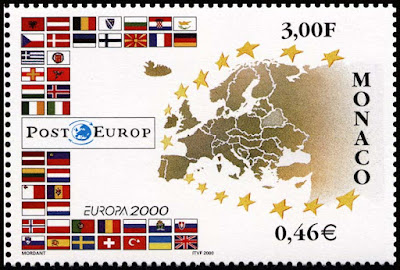
Though, the former logo was used once only (if I'm not wrong). On the second stamp of the 2000 Europa issue of Monaco 

And Belgium used it in the edge of the mini-sheet of their 2003 issue. They did it to celebrate the 10 years of PostEurop.

Sunday, July 7

Europa stamps video

Europe

The Exploring stamps YouTube channel dedicated an episode to the Europa stamps ! Watch it here and tell me in the comments what you think of it !!


Tuesday, September 20

France 1973 - focus

France

16th April 1973 - common design "Post, telegraph & telephone"
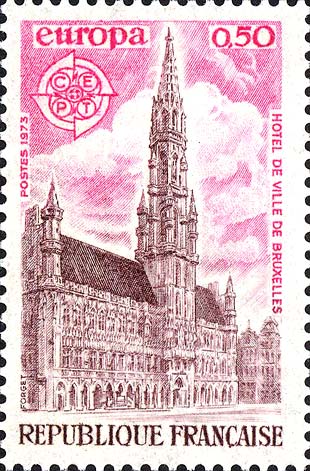
Hôtel de ville de Bruxelles
design & engraving: Pierre Forget
printer: Imprimerie des timbres-poste et des valeurs fiduciaires (ITVF)

1973 was the last year Europa stamps were issued using a common design. The main reason of this change was the monotony of common designs issues among philatelists. Before the introduction of a common theme in 1974, the CEPT introduced a new rule in 1971, the right to issue a second stamp with a free subject as design. One country who used that new rule from the start was France. Between 1971 and 1973, France issued a second stamp depicting a famous building of a European city (Venice in 1971, Aachen in 1972, Brussels in 1973).

I decided to focus on the 1973 stamp representing the town hall of Brussels. This stamp is part of a 2 stamps set, the other stamp depicting the common design made by the Norwegian artist Leif Frimann Anisdahl. This French stamp has been designed and engraved by the French artist Pierre Forget. He designed many stamps during his live for France, Monaco and Andorra. Besides this issue he is also the author of the 1975 french Europa issue. In 1979 he received the prize for the World's best stamp (!) for for the International year of the child french stamp. You can have a look at all Pierre Forget's stamps on this French stamp database: Phil-Ouest


The town hall of Brussels is a beautiful Gothic building from the Middle Ages. It is located on the Grand Place (market square) in the heart of Brussels' old town. This Saturday this building will be the showcase of the ceremony of the first "Best Europa stamp - Jury prize" ! PostEurop decided to give two Best Europa stamps prizes each year from now on: The Best Europa stamp will be selected as usual through the internet voting (held earlier this year on PostEurop's website) and the winner will be announced in October this year.

Besides this elder prize, a jury of 8 members composed by stamp designers, former philatelic managers and myself will select the stamp which will receive the first "Best Europa stamp - Jury prize" ! Next week you'll know who is the winner !

Monday, September 12

Great-Britain 1991 - focus

Great Britain

23rd April 1991 - "European aerospace"
design: Jean-Michel Folon
printer: Harrison & Sons Ltd

Many stamp collectors collects stamps related to space. They call it astrophilately or space philately. 1991 must have been an interesting Europa stamps year for all those collectors (as later 2009 with the Astronomy theme) but for my part space on stamps is not really my cup of tea. Rockets, satellites is a bit boring to me.

But two countries that year issued stamps with a more poetic touch, the Netherlands and Great-Britain. I will focus in this post on the British issue as I love the designer of those stamps : Jean-Michel Folon.


Folon was a Belgian painter and sculptor who produced many posters but also many stamps during his life. The set he produced for Great-Britain in 1991 is composed of 2 pairs of stamps. The first pair is called "Man looking at Space" and the second one "Space looking at Man". It is a very poetic point of view showing space through the eyes of man, how small we are in front of this immensity lost on our little blue planet. In the first pair of stamps the cosmos is our head as a dream and in the second one in our eyes more like a kind of reality.

If you are visiting Belgium one day, the Folon foundation in La Hulpe (near Brussels) is really worth a visit !

Thursday, September 8

Austria 1987 - focus

Austria

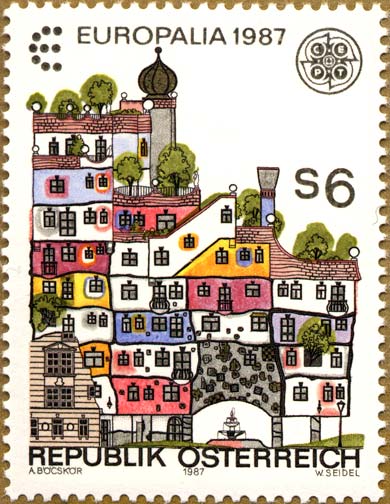
6th April 1987 - "Modern architecture"
design: Auguste Böcskör
engraving: Wolfgang Seidel
printer: Osterreichische Staatsdruckerei GmbH [OeSD]

I love architecture, that's why I love the 1987 Europa stamps year ! It is hard to take one stamp out of this year but I decided to focus on the Austrian stamp.


The stamp represent the Hundertwasserhaus in Vienna built between 1983 and 1986 by the City of Vienna. I was lucky enough to visit it when I visited the Austrian capital. This house is amazing, totally different of the usual standards we know in architecture. Lot's of colours, twisted walls, mosaics, mirors, trees on the roof, etc. It makes me think of a house coming out of a children drawing.

This house came out of the mind of Friedensreich Hundertwasser an Austrian architect who decided to build houses made of windows instead of walls. All his buildings are from the same type but the one depicted on the stamp is his most famous one, that's why it's simply called Hundertwasser-house !

Friedensreich Hundertwasser is not only an architect, he is also an artist who produced many stamps (mainly for Austria but also for Liechtenstein, the UN or more surprisingly for Cape Verde !), a website is even dedicated to them: http://www.hundertwasser-stamps.com

On the top left of the stamp you can see a little E logo. This is the logo of Europalia, an arts festival held every two years in Brussels celebrating one specific country and in 1987 it was Austria's turn. It's the first time that a Europa stamp is bearing this logo. This year's Europalia's invitee is Brazil.

Sunday, September 4

San Marino 1974 - focus

San Marino

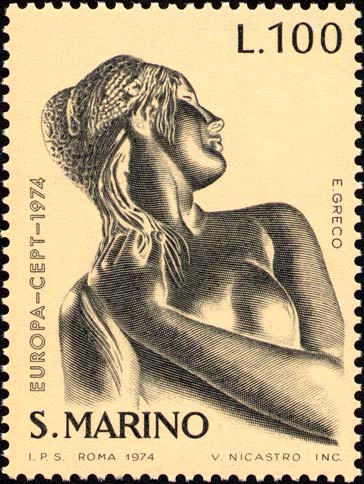
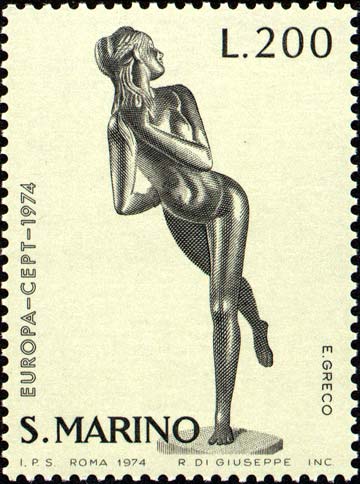
9th May 1974 - "Sculptures"
design: V. Nicastro & R. Di Giuseppe
printer: I.P.S. Roma

I decided to start a new type of messages to put a bit life in this blog when the Europa stamps season is a bit down.

I will focus on a stamp or set of the Europa stamps collection. This idea is inspired by the blog of Tomoko - well centred - I hope she won't mind !

The first set I chosed, is the 1974 issue of San Marino.


It's my favourite issue of that year. The beauty of the sculpture is very well given back by the quality of the engraving (two engravers for this set, one for each stamp !). It's also interesting to see that both stamps from this set are representing the same sculpture - a close up of the head and a full size image of the whole sculpture. One more thing I really like about this issue is the use of colored paper. It so much nicer than having a border around the stamp in my opinion. It emphasis the stamp on a cover especially a white one.


About the sculpture: it's a work of Emilio Greco, Italian sculptor born in Sicily almost hundred years ago. I think the work shown on both stamps is "Grande Pattinatrice n.2" (= great skater) of 1971. Surprisingly this sculpture can't be seen in San Marino but in Orvieto in Italy in the Emilio Greco Museum.

Thursday, October 16

50 years Europa CEPT

Europe

Europa 1956-2006
"50 years Europa CEPT"


In 2005 & 2006 several postal administrations issued stamps to commemorate the 50 years of the 1st Europa stamps issue.

Those stamps bared the CEPT logo and a special 50 years logo produced and used only for those commemorative issues.

Many countries, not only in Europe but also all around the World issued stamps for this event.

Here under you'll find the list of the European countries who took part at this issue.

01.10.2005 Albania - 2 stamps + 1 souvenir-sheet (200.-, 250.-, 500.- ALL)
28.03.2006 Armenia - 4 stamps + 1 souvenir-sheet of 4 stamps (4x 70.-, 4x 70.- AMD)
03.03.2006 Austria - 1 stamp (1.25 €)
25.10.2005 Azerbaijan - 4 stamps + 4 souvenir-sheets (those stamps exists also unperforated) (4x 3'000.- AZM)

30.11.2005 Bosnia and Herzegovina - 4 stamps + 1 souvenir-sheet of 4 stamps (those stamps exists also unperforated) (4x 3.- BAM)
15.01.2006 Bosnia and Herzegovina (Croat post) 4 stamps + 1 souvenir-sheet of 4 stamps (4x 2.-, 4x 2.- BAM)
30.08.2005 Bosnia and Herzegovina (Serb post) - 4 stamps + 1 souvenir-sheet of 4 stamps (4x 1.95, 4x 1.95 BAM)
28.05.2005 Bulgaria - 2 stamps (45.- & 80.- BGL)

08.09.2005 Croatia - 1 souvenir-sheet of 2 stamps (same stamps issued in sheets)) (7.20 & 8.- HRK)
23.02.2006 Cyprus - 1 souvenir-sheet of 4 stamps (4x 0.30 CYP)
06.01.2006 Cyprus (Turkish post) - 1 souvenir-sheet of 2 stamps (2x 1.40 YTL) (those stamps exists also unperforated)

04.01.2006 Estonia - 1 stamp + 1 souvenir-sheet (6.- + 6.50 EEK)

30.09.2005 Gibraltar - 1 stamp (5.- GBP) [!!!]
30.01.2006 Georgia - 4 stamps + 4 souvenir sheets of 1 stamp (those stamps exists also unperforated) (10.-, 20.-, 30.- 40.- + 4x 80.- GEL)
10.01.2006 Greece - 1 souvenir-sheet of 2 stamps
16.01.2006 Greenland - 1 stamp (26.50 DKK)

02.02.2006 Iceland - 1 souvenir-sheet of 2 stamps (2x 150.- ISK)
02.05.2006 Isle of Man - 1 souvenir-sheet of 2 stamps (0.42 & 0.83 GBP)

07.01.2006 Latvia - 4 stamps issued in sheets and 1 souvenir-sheet of 4 stamps (0.10, 2x 0.15, 0.20 + 0.10, 2x 0.15, 0.20 LVL)

14.11.2005 Macedonia - 1 souvenir-sheet of 4 stamps (also mini-sheets of 8 stamps) (60.-, 170.-, 250.-, 350.- MKD)
03.01.2006 Malta - 1 souvenir-sheet of 4 stamps (0.05, 0.13, 0.23, 0.24 MTL)
20.07.2005 Moldova - 2 stamps + 1 souvenir-sheet of 2 stamps (1.50 & 15.- & 1.50 & 15.- MDL)
03.01.2006 Montenegro - 4 stamps + 1 souvenir-sheet of 4 stamps + 1 unperf block (0.50, 1.-, 2x 2.- + 0.50, 1.-, 2x 2.- + 5.50 €)

22.08.2005 Romania - 4 stamps + 1 souvenir-sheet (same stamps issued in sheets) (those stamps exists also unperforated) (4x 4.70 RON)

31.03.2005 Serbia and Montenegro - 2 souvenir-sheets of 4 stamps each (4x 16.50 & 4x 41.50 YUD)
20.05.2005 Slovenia - 1 souvenir-sheet of 4 stamps (4x 60.- SIT)

15.12.2005 Turkey - 4 stamps + 1 souvenir-sheet of 4 stamps + 1 souvenir-sheet of 4 stamps unperforated (0.60, 0.70, 0.80, 1.- + 0.10, 0.25, 0.60, 0.70 + 0.10, 0.25, 0.60, 0.70 TRL)

05.01.2006 Ukraine - 2 stamps + 1 souvenir-sheet of 2 stamps (1.30, 2.50 + 1.30, 2.50 UAH)

Thursday, October 18

the Europa stamps history - IV

Europe

The Europa stamps history

part IV - The new Europe
(1990-1999)


The Iron curtain has fallen. The Europa stamps borders extend more to the east of the European continent.

Due to the end of the USSR and Yugoslavia, the nineties we will see many new countries joining the Europa stamps collection.

In 1990 (35 countries ; 78 stamps) the CEPT count new member countries already but they registered to late to take part at the Europa stamp issue dedicated
that year at the post office buildings. Hungary issued two stamps on the same topic but without the official CEPT logo that would have made real Europa stamps of them.

In 1991
(40 countries ; 83 stamps) the common theme was European aerospace and the first year that five countries, who were behind the Iron curtain some years before took part at the Europa stamps issue! Bulgaria, Czechoslovakia, Hungary, Poland & Romania where those five first ex-Communist countries to join.


In 1992 (42 countries ; 90 stamps) it was time to celebrate the 500 years of the discovery of the Americas by Columbus and the last year the CEPT logo was in use on Europa stamps. Albania took part for the first time producing an expensive first souvenir-sheet! Croatia was that year the first republic of ex-Yugoslavia to issue Europa stamps.

In 1993, the CEPT decided to concentrate on telecommunication issues only and the Europa stamps issues coordination was transmitted to PostEurop the association of European public postal operators. Since then a new logo is in use on Europa stamps :
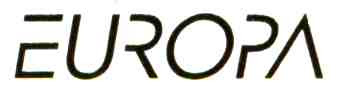

In 1993 (45 countries ; 92 stamps), the first year with the new Europa logo, the common theme was contemporary art. Lithuania, Moldova, Slovenia took part for the first time that year. Slovakia and the Czech Republic for the first time as two independent states and the Vatican took part again for the first time since 1969!

That year two unofficial issues appeared. The first one from: Belarus; although the new logo was introduced that year they used the old one on there stamps. The other one from the Croat post of Bosnia and Herzegovina. It was the first postal administration of Bosnia to issue Europa stamps but they weren't recognized by the UPU at that time, that's why their issue is also considered as unofficial.


In 1994 (48 countries ; 85 stamps) the new countries came from the North! Åland, Greenland, Estonia and Latvia took part for the first time. The theme was great discoveries that year.

The European construction leads to peace and welfare on the European continent. In 1995 (48 countries ; 90 stamps) it was time to celebrate the 50 years of the end of World War II. The Europa stamps celebrate it through the peace and freedom theme. Russia took part for the first time that year, but also Bosnia and Herzegovina. What a symbol for a country who suffered so much of the war during the 90's!

In 1996 (52 countries ; 89 stamps) it was time to celebrate the famous European women. New country to take part that year: Macedonia, it was also the last of the ex-republics of former Yugoslavia to issue Europa stamps.

In 1997 (54 countries ; 96 stamps) it was time for a theme that produced plenty of beautiful stamps: tales and legends. Armenia and the Ukraine took part for the first time and also the Serb post of Bosnia and Herzegovina but with an unofficial status. The next year, 1998 (56 countries ; 94 stamps) had festivals and national celebrations as common theme. Azerbaijan, Georgia took part that year for the first time as Belarus but for the first time with a legal issue. In 1999 (56 countries ; 100 stamps), nature reserves and parks.


Part I
- The early years (1956-1959)
~
Part II - The birth of the CEPT (1960-1973)
~
Part III - The common themes (1974-1989)

Thursday, August 2

the Europa stamps history - III

Europe

The Europa stamps history

part III - The common themes
(1974-1989)


1974 was an important year for the Europa stamps collection, because since then, a common theme replaced the common design system used since 1956! Only the CEPT logo (or letters) on each stamp indicates that the stamp is a "Europa stamp".
That year, the first theme to be chosen was sculptures (23 countries ; 49 stamps). The next year (1975) the theme was paintings (24 countries ; 50 stamps). It was also the first Europa issue of the Turkish part of Cyprus. Due to the political situation on the island of Cyprus, the stamps issued by the Turkish part of the island aren't recognized on an international level. Even if those stamps bear the Europa logo, they are not official Europa stamps but most of the Europa stamps collectors collect them as they issue Europa stamps on a regular basis since 1975 !


In 1976 the common theme was handicrafts (27 countries ; 58 stamps). Two new postal administrations appeared that year, Guernsey and the Isle of Man which still issue Europa stamps those days ! 1977 (28 countries ; 56 stamps), landscapes. 1978 (30 countries ; 65 stamps), monuments. Jersey took part for the first time that year. In 1979 (31 countries ; 68 stamps) the theme was postal history. The Faroe islands and Gibraltar are taking part since that year. Gibraltar isn't in fact a CEPT member but issue each year 4 stamps on the same topic as the Europa stamps but without the official logo. As they are British colony on European soil those issues were always tolerated.

The theme for 1980 (32 countries ; 67 stamps) was famous people. In 1981 (35 countries ; 69 stamps) the theme was folklore and feasts. For the first time the Azores and Madeira issued Europa stamps under their own name. 1982 (35 countries ; 70 stamps) : historic events. 1983 (35 countries ; 71 stamps) : inventions.


In 1984 (35 countries ; 67 stamps) the CEPT was 25 years old (1959-1984). To celebrate this event it has been decided to use a common design again as it was the case before 1974. The common design was a bridge designed by the French engraver Jacky Larrivière.

1985 (35 countries ; 73 stamps) was the European Music Year and the ideal topic for Europa stamps that year. 1986 (35 countries ; 74 stamps) : nature conservation. 1987 (35 countries ; 74 stamps) : modern architecture. 1988 (35 countries ; 79 stamps) : transportation . 1989 (35 countries : 80 stamps) : children's games.

Till 1981, the number of countries issuing Europa stamps grew up till a record number of 35, especially with the venue of Dependencies and Autonomous country parts. The number of 35 stayed stable until 1990 but the number of stamps grew up till a record number of 80 in 1989!

In November 1989 the Berlin Wall fell putting an end to the Iron curtain division between East and West, between the old and the new Europe. This brought many changes to the face of Europe not only politically but also culturally and also in the Europa stamps collection as we will see in the fourth part of this "Europa stamps history"...


Part I
- The early years (1956-1959)
~
Part II - The birth of the CEPT (1960-1973)
~

Part IV - The new Europe (1990-1999)
~
Part V - The new millennium (2000-)

Thursday, January 25

The Europa stamps history - II

Europe

The Europa stamps history

part II - The birth of the CEPT
(1960-1973)


1960 was the first official Europa CEPT issue and on that occasion 20 countries issued a total of 36 stamps, more than the double of 1959! For 11 countries it was their first Europa stamp issue (Denmark, Finland, Great-Britain, Greece, Iceland, Ireland, Liechtenstein, Norway, Portugal, Spain and Sweden). The common design was a Roman mail-coach wheel with 19 spokes designed by the Finnish artist, Pentti Rahikainen. (20 countries; 36 stamps).

That year, Liechtenstein issued their first Europa stamp (not with the common design). That issue, only 322'000 stamps, suffered of speculation and became very fast a must because of it's rarity.


During the next decade, the number of countries changed year by year, some countries stayed faithful other issued Europa stamps from time to time. Some smaller European countries issued their first stamps during that period.

1961 new: Cyprus and San Marino. The common design was a stylised dove made up of 19 individual doves designed by the Dutch artist Theo Kurpershoek. (16 countries; 34 stamps), 1962 new: Monaco. The common design was a stylised tree with 19 leaves designed by the Luxembourgian artist Lex Weyer. (18 countries; 39 stamps), 1963, common design a stylised cross, designed by the Norwegian artist Arne Holm. (19 countries; 36 stamps).

In 1964, for the 5 years of the CEPT, the design was a flower, designed by the French artist Georges Bétemps. (19 countries; 36 stamps).


1965, the design was a tree spring, designed by the Icelandic artist Hördur Karlsson. (19 countries; 36 stamps). The 3 leaves suggested to represent: Posts,Telegraphs & Telephone. 1966 new: Andorra (French post). The design that year was a ship designed by the German artists Gregor and Josef Bender. (19 countries; 37 stamps), In 1967, the common design represented cogwheels designed by the Belgian artist Oscar Bonnevalle. (19 countries; 37 stamps), 1968, the Swiss artist Hans Schwarzenbach designed a key with the CEPT logo in handle. (18 countries; 35 stamps).

In 1969 the CEPT celebrate their 10 years anniversary, it was the occasion for many countries to take part again at the Europa stamp issue, that's why we had 26 countries participating that year and 2 new countries the Vatican and Yugoslavia. (26 countries; 48 stamps). Yugoslavia was the first Communist country to take part ! That year the common design was a temple made of the words Europa and CEPT. The design was made by the Italian artists: Luigi Gasbarra and Georgio Belli.


During the Seventies the CEPT felt that the Europa stamps collectors started to get tired of all those similar designs. In 1970 they decided to allow each country to issue one stamp without the common design, thought this new rule wasn't followed by many countries.

1970 a sun composed of 24 interwoven wires designed by the Irish artist Louis Le Brocquy. (19 countries ; 42 stamps), 1971 new: Malta. The design of a chain was made by the Icelandic artist Helgi Haflidasson (21 countries ; 44 stamps).

1972 new: Andorra (Spanish post). Only 200'000 stamps were issued by the Spanish post of Andorra that year and a huge quantity of them were bought, by Spanish philatelist, in order to speculate. The result of it is that this stamp is now more than 200€ worth! The Finnish artist Paavo Huovinen represented an Aurora borealis as common design. (22 countries ; 46 stamps).


1973. The design that year, a stylised post horn, was made by the Norwegian artist Leif Frimann Anisdahl (24 countries ; 50 stamps). The 3 arrows are said to represent CEPT's primary objectives: posts,telgraphs and telephone services. 1973 was the last year the common design was used ! The next year a common theme will be introduced to make the collection more attractive and more interesting...


Part I
- The early years (1956-1959)
~
Part III - The common themes (1974-1989)

~
Part IV - The new Europe (1990-1999)
~
Part V - The new millennium (2000-)